Sunday, March 6, 2011

Chapter 14: The Origin of Species

Three questions about the chapter:
1.What is taxonomy?
Taxonomy is the branch of biology that names and classifies species and groups them into broader categories.
2.How many types of reproductive barriers are there?
There are two types of reproductive barriers - prezygotic and postzygotic.
3.Who were the people who most recently studied the evolution of Darwin's finches?
Peter and Rosemary Grant were the most people who studied the evolution of Darwin's finches most recently.

Five main facts about the chapter:
1.The origin of species is the source of biological diversity.
2.There are several ways to define a species.
3.Reproductive barriers keep species separate.
4.In allopatric speciation, geographic isolation leads to speciation.
5.Most plant species trace their origin to polyploid speciation.
 

Diagram:


This diagram shows the evolution of wheat.


 Link: http://www.flickr.com/photos/monado/sets/72157625811571540/detail/


Summary:
The introduction of the chapter talked about the rise and fall of cichlids, who live in Lake Victoria. Biologists often define a species as a group of organisms whose members can breed and produce fertile offspring, but who do not produce fertile offspring with members of other groups. Speiation is the emergence of a new species-is the bridge between microevolution and macroevolution. Next the chapter talked about that the origin of species is the source of biological diversity. There are sevral ways to define a species. Taxonomy is the branch of biology that names and classifies species and groups them into broader categories. The biological species concept was described in 1942 by biologist Ernst Mayr. It defines a species as a group of populations whose members have the potential to interbreed in nature and produce fertile offspring. Members of different species do not usually mate with each other. And, if members of one species do mate with members of anther species, the offspring will probably not be fertile. In effect, reproductive isolation prevents genetic exchange and maintains the gap between species. Other definitions of species are the morphological species concept, which has been used to identify most of the 1.8 million species that have been name to date, the ecological species concept, and the phylogenetic species concept. Reproductive barriers keep species separate. There are two main types of reproductive barriers - prezygotic, which prevent mating or fertilization between species, and postzygotic, which operate after hybrid zygotes are formed. In allopatric speciation, geographic isolation leads to speciation. In sympatric speciaton, speciation takes place without geographic isolation. New species formed in this way are polyploid. Most plant species trace their origin to polyploid speciation. Reproductive barriers may evolve as populations diverge. Hybrid zones provide opportunities to study reproductive isolation. Peter and Rosemary Grant study the evolution of Darwin's finches on Galapagos. Adaptive radiation may occur when new opportunities arise. Speciation can occur rapidly or slowly. 

Key Terms:
1.Species - a group of organisms whose members can breed and produce fertile offspring, but who do not produce fertile offspring with members of other groups.
2.Speciation - the emergence of new species.
3.Taxonomy - the branch of biology that names and classifies species and groups them into broader categories.
4.Biological species concept - defines a species as a group of populations whose members have the potential to interbreed in nature and produce fertile offspring.
5.Reproductive isolation - prevents genetic exchange and maintains the hap between species.
6.Reproductive barrier - a biological feature of the organism itself to prevent individuals of closely related species from interbreeding when their ranges overlap.
7.Prezygotic barriers - prevent mating or fertilization between species.
8.Postzygotic barriers - operate after hybrid zygotes are formed.
9.Adaptive radiation - the evolution of many diverse species from a common ancestor
10.Hybrid zones - regions in which members of different species meet and mate, producing at least some hybrid offspring.

Chapter 13: How Populations Evolve

Three questions about the chapter:
1.Where did Charles Darwin made most of his observation in order to come with the theory of evolution?
He did most of his observations in Galapagos.
2.What is the fossil record?
It is the sequence in which fossils appear within layers of sedimentary rocks-provides some of the strongest evidence of evolution.
3.What are some evidence that reinforce the evolutionary view of life?
Some of the evidence that reinforce the evolutionary of life are biogeography, comparative anatomy, and molecular biology.


Five main facts about the chapter:
1.Charles Darwin proposed natural selection as the mechanism of evolution.
2.Scientists can observe natural selection in action.
3.The study of fossils provides strong evidence for evolution.
4.Homologies indicate patterns of descent that can be shown of an evolutionary tree.
5.Populations are the units of evolution.


Diagram:


This diagram shows homologous structures: vertebrate forelimbs.


Link: http://www.myspace.com/roiscience


Summary:

The introduction of this chapter talked about the blue-footed boobies, which are well adapted and very interesting birds. Their big webbed feet, stream-lined shape, large tail, and specialized salt-excreting glands are all good examples of evolutionary adaptations. Charles Darwin came up with the study of evolution - the core theme of biology. A sea voyage helped Darwin frame his theory of evolution. The most important things that helped Darwin to form his theory of evolution were his cultural and scientific context, his sea voyage, his writings, and the study of fossils. Darwin also proposed natural selection as the mechanism of evolution. Darwin devoted much of On the Origin of Species to how organisms become adapted to their environment. First, he discussed familiar examples of domesticated plants and animals. Humans have modified other species by selecting and breeding individuals that possess desired traits - a process called artificial selection. Darwin then explained how a similar selection process could occur in nature, a process he called natural selection. Scientists can observe natural selection in action. The study of fossils provides strong evidence for evolution. Many of the fossils that paleontologists find in their digs are not the actual remnants of organisms at all, but are replicas of past organisms. The fossil record - the sequence in which fossils appear withing layers of sedimentary rocks-provides some of the strongest evidence of evolution. A mass of other evidence reinforces the evolutionary view of life. Some of them are biogeography, comparative anatomy, and molecular biology. Homologies indicate patterns of descent that can be shown on an evolutionary tree. Populations are units of evolution. In other words, a population is a group of individuals of the same species living in the same place at the same time. In studying evolution at the population level, biologists focus on what is called the gene pool, the total collection of genes in a population at any one time. Mutation and sexual reproduction produce genetic variation, making evolution possible. The Hardy-Weinberg equation can be used to test whether a population is evolving. It is also useful in public health science. Natural selection, genetic drift, and gene flow can alter allele frequencies in a population. Natural selection is the only mechanism that consistenly leads to adaptive evolution. It also can alter variation in a population in three ways: stabilizing selection, directional selection, and disruptive selection. Sexual selection may lead to phenotypic differences between males and females. Darwin was the first to explore the implications of sexual selection, a form of natural selection in which individuals with certain characteristics are more likely than other individuals to obtain mates. The evolution of antibiotic resistance in bacteria is a serious public health concern. Diploidy and balancing selection preserve genetic variation. Balancing selection occurs when natural selection maintains stable frequencies of two or more phenotypic forms in a population. Natural selection cannot fashion perfect organisms.


Key Terms
1. Evolution - the core theme of biology.
2.Artificial selection - the process by which humans have modified other species by selecting and breeding individuals that possess desired trait. 
3.Fossil record - the sequence in which fossils appear within layers of sedimentary rocks-provides some of the strongest evidence of evolution.
4.Biogeography - the geographic distribution of species.
5.Vestigial organs - structures that are of marginal or perhaps no importance to the organism.
6.Population - a group of individuals of the same species living in the same place at the same time.
7.Mutation - a change in the nucleotide sequence of DNA.
8.Genetic drift - a change in the gene pool of a population due to chance.
9.Founder effect - differences in a gene pool of a small colony compared with the original population.
10.Sexual dimorphism - the distinction in appearance.

Chapter 12: DNA Technology and Genomics

Three questions about the chapter:
1.When was the first time when a DNA sample solved a criminal case?
It happened in 1986, when professor Alec Jeffrey compared two samples of DNA and solved the case.
2.What are enzymes used for in DNA process?
Enzymes are used to "cut and paste" DNA.
3.What organisms have been cloned already?
Many plant and animal species have been already cloned, but a human being has not, and probably will not in the close future, due to ethical issues.


Five main factors from the reading:
1.Genes can be cloned in recombinant plasmids.
2.Cloned genes can be stored in genomic libraries.
3.Reverse transcriptase can help make genes for cloning.
4.Nucleic acid probes identify clones carrying specific genes.
5.Recombinant cells and organisms can mass-produce gene products.


Diagram:

 This is an example of real RFLP analysis.


Link: http://www.cdc.gov/ncidod/eid/vol4no2/kordick.htm


Summary:


The introduction of the chapter talked about DNA and crime scene investigations. It gave us the first case in which DNA solved a criminal case, by comparing a sample of DNA left at the crime and a sample taken from the person who did it. It also explained us what DNA technology is. It is the methods for studying and manipulating genetic material and it has rapidly revolutionized the field of forensics, the scientific analysis of evidence for legal investigations. The next part of the chapter talked about that genes can be cloned in recombinant plasmids. Although it may seem like a modern field, biotechnology, the manipulation of organisms or their components to make useful products, actually dates back to the dawn of civilization. In the 1970s, the uses of biotechnology exploded with the invention of methods for making recombinant DNA in the laboratory. Recombinant DNA is formed when scientists combine nucleotide sequences (pieces of DNA) from two different sources-often different species-to form a single DNA molecule. To manipulate genes in the laboratory, biologists often use bacterial plasmids, which are small, circular DNA molecules that replicate separately from the much larger bacterial chromosome. Because plasmids can carry virtually any gene and are passed on from one generation of bacteria to the next, they are key tools for gene cloning, the production of multiple identical copies of a gene-carrying piece of DNA. Gene-cloning methods are central to genetic engineering, the branch of biotechnology that involves the direct manipulation of genes for practical purposes. Enzymes are used to "cut and paste" DNA. In the gene-cloning procedure, a piece of DNA containing the gene of interest must be cut out of a chromosome and "pasted"into a bacterial plasmid. The cutting tools used are bacterial enzymes called restriction enzymes. Cloned genes can be stored in genomic libraries. Most bacterial clones consist of identical cells with recombinant plasmids carrying one particular fragment of target DNA. The entire collection of all the cloned DNA fragments from a genome is called a genomic library. Reverse transcriptase can help make genes for cloning. The DNA that results from such a procedure, called complementary DNA, represents only the subset of genes that had been transcribed into mRNA in the starting cells. Nucleic acid probes identify clones carrying specific genes. Recombinant cells and organisms can mass-produce gene products. DNA technology has changed the pharmaceutical industry and medicine. It is mostly used for therapeutic hormones, such as insulin, diagnosis and treatment of disease, and vaccines. Genetically modified organisms are transforming agriculture. Genetic engineers have produced many varieties of genetically modified organisms, ones that have acquired one or more genes by artificial means. If the newly acquired gene is from another species, the recombinant organism is called a transgenic organism. However, genetically modified organisms raise concerns about human and environmental health. Gene therapy may someday help treat a variety of diseases. One reason to tamper with the human genome is the potential for treating a variety of diseases by gene therapy - alteration of an afflicted individual's genes. The analysis of genetic markers can produce a DNA profile. The most important application of biology to forensics is DNA profiling, the analysis of DNA fragments to determine whether they come from a particular individual. The PCR method is used to amplify DNA sequences. Cloning DNA in host cells is often the best method for preparing large quantities of DNA from a particular gene. However, when the source of DNA is scanty or impure, the polymerase chain reaction (PCR) is a much better method. Gel electrophoresis sorts DNA molecules by size. Many approaches for studying DNA molecules make use of gel electrophoresis. This technique uses a gel as a molecular sieve to separate macromolecules - usually proteins or nucleic acids-on the basis of size, electrical charge, or other physical properties. STR analysis is commonly used for DNA profiling. Repetitive DNA consists of nucleotide sequences that are present in multiple copies in the genome; much of the DNA that lies between genes in humans is of this type. DNA profiling has provided evidence in many forensic investigations. RFLPs can be used to detect differences in DNA sequences. Genomics is the scientific study of whole genomes. The Human Genome Project revealed that most of the human genome does not consist of genes. The whole-genome shotgun method of sequencing a genome can provide a wealth of data quickly. Proteomics is the scientific study of the full set of proteins encoded by a genome. Genomes hold clues to the evolutionary divergence of humans and chimps.


Key Terms:


1.Biotechnology - the manipulation of organisms or their components to make useful products.
2.DNA technology - methods for studying and manipulating genetic material.
3.Plasmids - small, circular DNA molecules that replicate separately from the much larger bacterial chromosome.
4.Gene cloning - the production of multiple identical copies of a gene-carrying piece of DNA.
5.Genetic engineering - the branch of biotechnology that involves the direct manipulation of genes for practical purposes.
6.Restriction site - the DNA sequence recognized by a particular restriction enzyme.
7.Genomic library - the entire collection og all the cloned DNA fragments from a genome.
8.Vaccine - a harmless variant or derivative of a pathogen that is used to stimulate the immune system to mount a defense against the pathogen.
9.Gene therapy - alteration of an afflicted individual's genes.
10.DNA profiling - the analysis of DNA fragments to determine whether they come from a particular individual.

Tuesday, March 1, 2011

Chapter 11: How Genes Are Controlled

Three questions about the chapter:
1.What is gene expression?
It is the overall process by which genetic information flow from genes to proteins-that is, from genotype to phenotype.
2.What are the histones used for?
Histones are small proteins that help DNA packing by supporting the shape of the DNA.
3.Do small RNAs have a role in gene expression?
Yes, they do. The micro RNAs can bind to complementary sequences on mRNA molecules. They can degrade mRNA or block its translation.


Five main factors from the reading:
1.Proteins interacting with DNA turn prokaryotic genes on or off in response to environmental changes.
2.DNA packing in eukaryotic chromosomes helps regulate gene expression.    
3.In female mammals, one X chromosome is inactive in each somatic cell.
4.Cascades of gene expression direct the development of an animal.
5.DNA micro-arrays test for the transcription of many genes at once.


Diagram:
 This diagram represents the processes of turning on and off the lac operon.


Link: http://www.accessexcellence.org/RC/VL/GG/induction.php


Summary:

The introduction of the chapter was talking cloning. A clone is an individual created by asexual reproduction and thus genetically identical to a single parent. After this we learned that proteins interacting with DNA turn prokaryotic genes on or off in response to environmental changes. Gene regulation - the turning on and off of genes - can help organisms respond to environmental changes. The overall process by which genetic information flows from genes to proteins-that is, from genotype to phenotype-is called gene expression. The control of gene expression makes it possible for cells to produce specific kinds of proteins when and where they are needed. The turning on and off of transcription is the main way that gene expression is regulated in all organisms.The chapter talked about the lac operon and the trp operon. Adjacent to the group of lactose enzyme genes are two control sequences, short sections of DNA that help control the enzyme genes. One stretch of nucleotides is a promoter, as site where the transcription enzyme, RNA polymerase, attached and initiates transcription. Between the promoter and the enzyme genes, a DNA segment called an operator acts as a switch. The operator determines whether RNA polymerase can attach to the promoter and start transcribing the genes. Such a cluster of genes with related functions, along with a promoter and an operator, is called an operon. A gene called a regulatory gene, located outside the operon, codes for the repressor. Another type of operon control involves activators, proteins that turn operons on by binding to DNA. Differentiation is the process by which cells become specialized in structure and function. Differentiation results from the expression of different combinations of genes. DNA packing in eukaryotic chromosomes helps regulate gene expression. A crucial aspect of DNA packing is the association of the DNA with small proteins called histones. In fact, histone proteins account for about half the mass of eukaryotic chromosomes. In female mammals, one X chromosome is inactive in each somatic cell. Female mammals, including humans, inherit two X chromosomes. So why don;t females make twice as much of the proteins encoded by genes on the X chromosome compared to the amount in males? it turns out that in female mammals, one X chromosome in each somatic cell exists in a highly compacted and almost entirely inactive form. This X chromosome inactivation is initiated early in embryonic development, when one of the two X chromosomes in each cell is inactivated at random. The inactive X in each cell of a female condenses into a compact, called a Barr body. Complex assemblies of proteins control eukaryotic transcription. In order to function, eukaryotic RNA polymerase requires the assistance of proteins called transcription factors. Eukaryotic RNA may be spliced in more than one way. With an alternative RNA splicing, an organism can get more than one type of polypeptide from a single gene. Small RNAs play multiple roles in controlling gene expression. Translation and later stages of gene expression are also subject to regulation. After a eukaryotic mRNA is fully processed and transported to the cytoplasm, there are additional opportunities for regulation. These include mRNA breakdown, initiation of translation, protein activation, and protein breakdown. Cascades of gene expression direct the development of an animal. A homeotic gene is a master control gene that regulates batteries of other genes that actually determine the anatomy of parts of the body. DNA microarrays test for the transcription of many genes at once. A DNA microarray is a glass slide with thousands of different kinds of single-stranded DNA fragments fixed to it in a tightly spaced array, or grid. Signal transduction pathways convert messages received at the cell surface to responses within the cell. Cell-to-cell signaling, with proteins or other kinds of molecules carrying messages from signaling cells to receiving cells is a key mechanism in the coordination of cellular activities. In most cases, a signal molecule acts by binding to a receptor proteins in the plasma membrane of the target cell and initiating a signal transduction pathway in the cell. Cell-signaling systems appeared early in the evolution life. Plant cloning shows that differentiated cells may retain all of their genetic potential. Nuclear transplantation can be used to close animals. Reproductive cloning has valuable applications, but human reproductive cloning raises ethical issues. Therapeutic cloning can produce stem cells with great medical potential. Cancer results from mutations in genes that control cell division. Multiple genetic changes underlie the development of cancer. Faulty proteins can interfere with normal signal transduction pathways. Lifestyle choices can reduce the risk of cancer.


Key Terms:
1.Clone - an individual created by asexual reproduction.
2.Operon - a cluster of genes with related functions, along with a promoter and an operator.
3.Differentiation - an individual's cells become specialized in structure and function.
4.Homeotic gene - a master control gene that regulates batteries of other genes that actually determine the anatomy of parts of the body.
5.DNA microarray - a glass slide with thousands of different kinds of single-stranded DNA fragments fixed to it in a tightly spaced array, or a grid.
6.Nuclear transplantation - the technique used to achieve animal cloning.
7.Reproductive cloning - a type of cloning, which results in birth of a new individual.
8.Therapeutic cloning - when the major aim is to produce embryonic stem cells for therapeutic treatments.
9.Adult stem cells - cells that are able to give rise to many but not all cell types in the organism.
10.Oncogene - a gene, which can cause cancer when present in a single copy in the cell. 

Monday, January 24, 2011

Chapter 10: Molecular Biology of the Gene

Three questions about the chapter:
1.What contains the genetic material?
Experiments showed that DNA is the genetic material.
2.What are the four nucleotides found in DNA?
They are thymine (T), cytosine (C), adenine (A), and guanine (G).
3.What are the four nucleotides found in RNA?
They are uracil (U), cytosine (C), adenine (A), and guanine (G).


Five main facts from the reading:
1.DNA is a double-stranded helix.
2.DNA replication depends on specific base pairing.
3.Genetic information written in codons is translated into amino acid sequences.
4.Transcription produces genetic messages in the form of RNA.
5.Transfer RNA molecules serve as interpreters during translation.

Diagram:
  
  This diagram represents the process of DNA transcription to RNA.


Link: http://www.sequencing-gene.com/sequencing-gene/dna-transcription


Summary:
  The introduction of this chapter talked about the way viruses enter a host, and start multiplying and making new copies of themselves, based on the host's provisions. A virus is simply nucleic acid wrapped in a coat of protein and for herpesviruses and some other animal viruses, a membranous envelope. This chapter taught us about molecular biology, the study of DNA and how it serves as the chemical basis of heredity. In the past scientists had hard time to find out which part was the genetic material. They were in front of a dilemma between the DNA and the protein. However, experiments showed that DNA is the genetic material. We can trace the discovery of the genetic role of DNA back to 1928. British medical officer Frederick Griffith was studying two strains of a bacterium: a harmless strain and a pathogenic strain that causes pneumonia. Griffith was surprised to find that when he killed the pathogenic bacteria and then mixed the bacterial remains with living harmless bacteria, some living bacterial cells were converted to the disease-causing form. Most biologists doubted that DNA could be Griffith's transforming factor, primarily because there was not a lot of information for DNA. However, in 1952, Alfred Hershey and Martha Chase performed a set of experiments, which shows that DNA is the genetic material of a virus called T2, which infects the bacterium E. coli. Bacterial viruses are called bacteriophages or just phages. DNA and RNA are polymers of nucleotides. One year after Hershey and Chase published their results, scientists figured out the three-dimensional structure of DNA and the basic strategy of how it works. The four nucleotides found in DNA differ only in their nitrogenous bases. Thymine (T) and cytosine (C) are single-ring structures called pyrimidines. Adenine (A) and guanine (G) are larger, double-ring structures called purines. The one-letter abbreviations can be used for either the bases alone of for the nucleotides containing them. In RNA, instead of thymine, RNA has a nitrogenous base called uracil (U). James Watson and Francis Crick discovered that the DNA is a double-stranded helix in 1953. DNA replication depends on specific base pairing. The most famous model for DNA replication is knows as semi-conservative model, because half of the parental molecule is maintained in each daughter molecule. This model was confirmed by experiments performed in the 1950s. DNA replication proceeds in two directions at many sites simultaneously. Each strand has a 3' end and a 5' end. The enzymes that link DNA nucleotides to a growing daughter strand called DNA polymerases, add nucleotides only to the 3' end of the strand, never to the 5' end. So, a daughter DNA strand can only grow in the 5' to 3' direction. Another important enzyme, called DNA ligase, links the separated pieces together into a single DNA strand. The DNA genotype is expressed as proteins, which provide the molecular basis for phenotypic traits. The two main stages that take place after replication are transcription, the transfer of genetic information from DNA into an RNA molecule, and translation, the transfer of the information in the RNA into a protein. Genetic information written in codons is translated into amino acid sequences. Experiments have verified that the flow of information from gene to protein is based on a triplet code: The genetic instructions fro the amino acid sequence of a polypeptide chain are written in DNA and RNA as a series of three-base words, called codons. The genetic code is the set of rules giving the correspondence between codons in RNA and amino acids in proteins. The Genetic code is also called the Rosetta stone of life. Transcription produces genetic messages in the form of RNA. The "starting transcribing" signal is a nucleotide sequence called a promoter. Eukaryotic RNA is processed before leaving the nucleus. The kind of RNA that encodes amino acid sequences is called messenger RNA (mRNA) because it conveys genetic information from DNA to the translation machinery of the cell. The RNA has internal noncoding regions called introns, and coding regions called exons. Before the RNA leaves the nucleus, the introns are removes, and the exons are joined to produce an mRNA molecule with a continuous coding sequence. This cutting-and-pasting process is called RNA splicing. Transfer RNA molecules serve as interpreters during translation. To convert the three-letter words (codons) of nucleic acids to the one-letter, amino acid words of proteins, a cell employs a molecular interpreter, a special type of RNA called transfer RNA (tRNA). Ribosomes build polypeptides. A ribosome consists of two subunits, each made up of proteins and a kind of RNA called ribosomal RNA (rRNA). An initiation codon marks the start of an mRNA message. Transcription and translation have three stages: initiation, elongation, which adds amino acids to the polypeptide chain until a stop codon terminates translation, and termination. Mutations can change the meaning of genes. Any change in the nucleotide sequence of DNA is called a mutation. Viral DNA may become part of the host chromosome. Many viruses cause disease in animals and plants. bacteria can transfer DNA in three ways: transformation, transduction, and conjugation. Also bacterial plasmids can serve as carriers fro gene transfer.


Key Terms:
1. Virus - simply nucleic acid wrapped in a coat of protein.
2. Molecular biology - the study of DNA and how it serves as the chemical basis of heredity.
3.  Nucleotides - long chains of chemical units.
4. DNA Polymerases - the enzyme that links DNA nucleotides to a growing daughter strand.
5. DNA Ligase - the enzyme that links the pieces together into a single DNA strand.
6. Transcription - the transfer of genetic information from DNA into an RNA molecule.
7. Translation - the transfer of the information in the RNA into a protein.
8. Genetic code - the set of the rules giving the correspondence between codons in RNA and amino acids in proteins.
9. RNA splicing - the process of cutting-and-pasting introns and exons.
10. Mutation - any change in the nucleotide sequence of DNA. 

Sunday, November 28, 2010

Chapter 9: Patterns of Inheritance

Three questions about the chapter:
1.When did the modern science of genetics begin and who was its founder?
The modern science of genetics began in the 1860s, when an Augustinian monk named Gregor Mendel deduced the fundamental principles of genetics by breeding garden peas.
2.What does the law of segregation states?
It states that a perm or egg carries only one allele for each inherited charcater because allele pairs separate from each other during the production of gametes.
3.Do sex-linked disorders affect more men or women?
Sex-linked disorders affect mostly males.

Five main facts from the reading:
1. The science of genetics has ancient roots.
2.Genetic traits in humnas can be tracked through family pedigrees
3.Many inherited disorders in humans are controlled by a single gene.
4.Many genes have more than two alleles in the population.
5.A single character may be influence by many genes.

Diagram:


This is an example of a Punnet square, which represents the fertilization between a male and female flower.


Link: http://bio8.wikispaces.com/4%29Mendelian+Genetics


Summary:
     The introduction section of the chapter talks about that there are many different types of dogs, due to the fact that when one type of a dog fertilizes another type of a dog, the production is a new type of a dog, similar to its parents. Genetics is the science of heredity and it has ancient roots. The first person to purpose an explanation to genetics was the physician Hippocrates, and even though he was not right, he put the basis of genetics. Experimental genetics began in an abbey garden. The modern science of genetics began in the 1860s, when an Augustinian monk named Gregor Mendel deduced the fundamental principles of genetics by breeding garden peas. He correctly argued that parents pass on to their offspring discrete heritable factors. A heritable feature that varies among individuals, such as flower color, is called a character. Each variant for a character, such as purple or white flowers, is called a trait. Perhaps the most important advantage of pea plants as an experimental model was that Mendel could strictly control matins. Consequently, pea plants usually self-fertilize in nature. That is, sperm-carrying pollen grains released from the stamens land on the egg-containing carpel of the same flower. He also used cross-fertilization sometimes, which is fertilization of one plant by pollen from a different plant. Mendel worked with his plants until he was sure he had true-breeding varieties - that is, varieties for which self-fertilization produced offspring all identical to the parent. In the language of plant and animal breeders and geneticists, the offspring of two different varieties are called hybrids, and the cross-fertilization itself is referred to as a hybridization, or simply a cross. The true-breeding parental plants are called the P generation, and their hybrid offspring are the F1 generation. When F1 plants self-fertilize or fertilize each other, their offspring are the F2 generation. Mendel's law of segregation describes the inheritance of a single character. A cross between a pea plant with purple flowers and one with white flowers is called a monohybrid cross, because the parent plants differ in only one character. There are alternative versions of genes that account for variations in inherited characters. For example, the gene for flower color in pea plants exists in two versions, one for purple and the other for white. The alternative versions of a gene are now called alleles. For each character, an organism inherits two alleles, one from each parent. These alleles may be the same or different. An organism that has two identical alleles for a gene is said to be homozygous for that gene. An organism that has two different alleles for a gene is said to be heterozygous for that gene. If the two alleles of an inherited pair differ, then one determines the organism;s appearance and is called the dominant allele; the other has no noticeable effect on the organism;s appearance ans is called the recessive allele. A sperm or egg carries only one allele for each inherited character because allele pairs separate from each other during the production of gametes. Because an organism's appearance does not always reveal its genetic composition, geneticists distinguish between an organism;s expressed, or physical, traits, called its phenotype, and its genetic makeup its genotype. Homologous chromosomes bear the alleles for each character. The law of independent assortment is revealed by tracking two characters at once. A dihybrid cross is a mating of parental varieties differing in two characters. Each pair of alleles segregates independently of other pairs of alleles during gamete formation. This is called Mendel's law of independent assortment. Geneticists use the testcross to determine unknown genotypes. A testcross is a mating between an individual of unknown genotype and a homozygous recessive individual. Mendel's laws reflect the rules of probability. Genetic traits in humans can be tracked through family pedigrees, by going back to the previous generations and finding out if they had the trait or not. many inherited disorders in humans are controlled by a single gene. Most human genetic disorders are recessive. They range in severity from relatively mild, such as albinism, to life-threatening, such as cystic fibrosis. Most people who have recessive disorders are born to normal parents who are both heterozygous - that is who are carriers of the recessive allele for the disorder but are phenotypically normal.Although many harmful alleles are recessive, a number of human disorders are caused by dominant alleles. New technologies can provide insight into one's genetic legacy. There are several ways of testing: genetic testing, fetal testing, fetal imaging, which uses ultrasound imaging, newborn screening, and ethical considerations. Incomplete dominance results in intermediate phenotypes. The F1 offspring of Mendel's pea crosses always looked like one of the two parental varieties. This situation is called complete dominance; the dominant allele has the same phenotypic effect whether present in one or two copies. But for some characters, the appearance of F1  hybrids falls between the phenotypes of the two parental varieties, an effect called incomplete dominance. Many genes have more than two alleles in the population. For instance, the ABO blood group phenotype in humans involves three alleles of a single gene. A single gene may affect many phenotypic characters. Most gene influence multiple characters, a property called pleiotropy. A single character may be influenced by many genes. Mendel studied genetic characters that could be classified on an either-or basis, such as purple or white flower color. However, many characteristics, such as human skin color and height, vary in a population along a continuum. Many such features result from polygenic inheritance, the additive effects of two or more genes on a single phenotypic character. The environment also affects many characters. Chromosome behavior accounts for Mendel's laws. Genes on the same chromosome tend to be inherited together. Genes located close together on the same chromosome tend to be inherited together and are called linked genes. Crossing over produces new combinations of alleles.  Geneticists use crossover data to map genes. Chromosomes determine sex in many species. Many animals, including all mammals, ahve apir of sex chromosomes, designed X and Y, that determine an individual's sex. Sex-linked genes exhibit a unique pattern of inheritance. A sex-linked gene is a gene located on either sex chromosome, and it is a lot different than a linked-gene. Sex-linked disorders affects mostly males. Hemophilia, red-green color blindness. and Duchenne muscular dystrophy are disorders caused by sex-linked genes, and they are seen more often in males, than in females. The Y chromosome is also very valuabe, because provides clues about human male evolution.

Key Terms:
1.Character - a heritable feature that varies among individuals, such as flower color.
2.Trait - each variant for a character, such as purple or whit flowers.
3.Hybrids - the offspring of two different varieties.
4.Alleles - the alternate versions of a gene.
5.Homozygous - an organism that has two identical alleles for a gene.
6.Heterozygous - an organism that has two different alleles for a gene.
7.Achondroplasia - a serious dominant disorder; a form of dwarfism.
8.Huntington's diseas - a degenerative disorder of the nervous system that usually does not appear until 35 to 45 years of age.
9.Complete dominance - the dominant allele has the same phenotypic effect whether present in one or two copies.
10.Incomplete dominance - the appearance of F1 hybrids falls between the phenotypes of the two parental varieties.

Chapter 8: The Cellular Basis of Reproduction and Inheritance

Three questions about the chapter:
1.Where do cells arise from?
Cells arise only from preexisting cells.
2.What are the two main stages of the cell cycle?
The cell ycle consists of two broad stages: a growing stage (called interphase) and the actual cell division (called the mitotic phase).
3.What can happen if a person has an extra copy of chromosome 21?
There is a chance that this person might have the Down syndrome.

Five main facts from the reading:
1.Prokaryotes reproduce by binary fission.
2.The large, complex chromosomes of eukaryotes duplicate with each cell division.
3.The cell cycle multiplies cells.
4.Cell division is a continuum of dynamic changes.
5.Cytokinesis differ for plant and animal cells.

Diagram:


    This diagram shows an example of binary fission of a prokaryotic cell.


Link: http://www.tutorvista.com/biology/transverse-binary-fission 


Summary:
     The introduction of the chapter talked about people who are trying to safe different plant species, because they are not very many of these kinds left. It also talked about life cycle, which is the sequence of stages leading from the adults of one generation to the adults of the next. Sperm and egg each carry one set of genetic information - one copy of the organism's genome.Like begets like is an adage that applies only to asexual reproduction, the creation of genetically identical offspring by a single parent, without the participation of sperm and egg. For example an amoeba is an organism which duplicates its chromosomes, the structures that contain most of the organism's DNA. Offspring produced by sexual reproduction generally resemble their parents more closely than they resemble unrelated individuals of the same species, but they are not identical to their parents or to each other. Cells arise only from preexisting cells. The reproduction of cells is called cell division. Prokaryotes reproduce by a type of cell division called binary fission.The large, complex chromosomes of eukaryotes duplicate with each cell division. These cells are more complex and generally much larger than prokaryotic cells, and they have many more genes. Almost all the genes in the cells of humans, and in all other eukaryotes, are found in the cell nucleus, grouped into multiple chromosomes. Most of the time, chromosomes exist as a diffuse mass of long, thin fibers.This material, called chromatin, is a combination of DNA and protein molecules. Before a eukaryotic cell begins to divide, it duplicates all of its chromosomes. The DNA molecule of each chromosome is copied, and new protein molecules attach as needed. The result is that each chromosome now consists of two copies called sister chromatids,w hich contain identical copies of the DNA molecule. Two chromatids are joined together especially tightly at a narrow "waist" called the centromere. The cell cycle multiplies cells. It is an ordered sequence of events that extends from the time a cell is first formed from a dividing parent cell until its own division into two cells. The cell cycle consists of two broad stages: a growing stage (called interphase), during which the cell roughly doubles everything in its cytoplasm and precisely replicates its chromosomal DNA, and the actual cell division (called the mitotic phase). The mitotic phase is divided into two stages, called mitosis and cytokinesis, although the second stage begins before the first one ends. In mitosis, the nucleus and its contents, including the duplicated chromosomes, divide ad are evenly distributed to form two daughter nuclei. During cytokinesis, the cytoplasm is divided in two. Mitosis is a continuum of changes, but there are five main distinguished stages: prophase, prometaphase, metaphase, anaphase, and telophase. Cytokinesis differs for plant and animal cells. Anchorage, cell, cell density, and chemical growth factors affect cell division. A growth factor is a protein secreted by certain body cells that stimulates other cells to divide. The effect of a physical factor on cell division is clearly seen in density-dependent inhibition, a phenomenon in which crowded cells stop dividing. Growth factors signal the cell cycle control system. This system is a cyclically operating set of molecules in the cell that both triggers and coordinates key events in the cell cycle. Growing out of control, cancer cells produce malignant tumors.A tumor is an abnormally growing mass of body cells. If the abnormal cells remin at the original site, the lump is called a benign tumor. In contrast, a malignant tumor can spread into neighboring tissues and other parts of the body, displacing normal tissue and interrupting organ function as it goes. The spread of cancer cells via the circulatory system beyond their original site is called metastasis. In short, mitosis provides for growth, cell replacement, and asexual reproduction. In humans, a typical body cell, called a somatic cell, has 46 chromosomes. They are matched in homologous pairs. X and Y chromosomes are called sex chromosomes. The other 22 pairs of chromosomes are called autosomes. Gametes are the egg and sperm cells, and they have a single set of chromosomes. Any cell with two homologous sets of chromosomes is called a diploid cell. A cell with a single chromosome set is called a haploid cell. Meiosis is a type of cell division that produces haploid gametes in diploid organisms. Mitosis and meiosis have many important similarities and differences. Independent orientation of chromosomes in meiosis and random fertilization lead to varied offspring. Homologous chromosomes can carry different versions of genes. Crossing over is an exchange of corresponding segments between two homologous chromosomes. A karyote is a photographic inventory of an individual's chromosomes. If a person has 47 chromosomes, instead of 46, the condition is called trisomy 21. An extra copy of chromosome 21 causes Down syndrome. Accidents during meiosis can alter chromosome number. Abnormal numbers of sex chromosomes do not usually affect survival. New species can arise from errors in cell division. Alternations of chromosome structure can cause birth defects and cancer.

Key Terms:
1.Life cycle - the sequence of stages leading from the adults of one generation to the adults of the next.
2.Asexual reproduction - the creation of genetically identical offspring by a single parent, without the participation of sperm and egg.
3.Cell division - the reproduction of cells.
4.Chromatin - a combination of DNA and protein molecules.
5.Cell cycle - an ordered sequence of events that extends from the time a cell is first formed from a dividing parent cell until its own division into two cells.
6.Cytokinesis - a process during which the cytoplasm is divided in two.
7.Cleavage furrow - a shallow groove in the cell surface.
8.Growth factor - a protein secreted by certain body cells that stimulates other cells to divide.
9.Tumor - an abnormally growing mass of body cells.
10.Metastasis - the spread of cancer cells via the circulatory system beyond their original site.

Friday, November 26, 2010

Chapter 7: Photosynthesis

Three questions about the chapter:
1.What process do plants use that eukaryote organisms do not, to get energy?
 Photosynthesis.
2.Where does photosynthesis occur?
It occurs in the chloroplasts in plant cells.
3.What are the two stages of photosynthesis?
The first one is the light reactions, and the second one is the Calvin cycle, or the dark reactions.

Five main facts from the reading:
1.Autotrophs are the producers of the biosphere.
2.Plants produce oxygen by splitting water.
3.Photosynthesis is a redox process,as is cellular respiration.
4.Photosynthesis uses light energy, carbon dioxide, and water to make food molecules.
5.Photosynthesis moderates global warming. 

Diagram:
 This diagram is a simple overview of the two stages of photosynthesis that take place in a chloroplast.


Link: http://www.calpoly.edu/~mforte/dream/p3.html


Summary:
     In the introduction of the chapter, we learned that scientists are trying to use plant power as fuel source. Photosynthesis is one of the oldest energy pathways on the planet. In this process, green plants, algae, and certain bacteria transform light energy to chemical energy stored in the bonds of the sugar they make from carbon dioxide and water. After this we learned that autotrophs are the producers of the biosphere. Producers are the organisms that produce their own food supply. All organisms that produce organic molecules from inorganic molecules using the energy of light are called photoautotrophs. Photosynthesis occurs in the chloroplasts in plant cells. Plants' green color is from chlorophyll, a light-absorbing pigment in the chloroplasts that plays a central role in converting solar energy to chemical energy. Chloroplasts are concerned in the cells of the mesophyll, the green tissue in the interior of the leaf. Carbon dioxide enters the leaf, and oxygen exits, by way of tiny pores called stomata. Water absorbed by the roots is delivered tot he leaves in veins. An envelope of two membranes encloses an inner compartment in the chloroplast, which is filled with a thick fluid called stroma. Suspended in the stroma is a system of interconnected membranous sacs, called thylakoids. In some places thylakoids are concentrated in stacks called grana. Plants produce oxygen by splitting water. Photosynthesis is a redox process, as is cellular respiration. It has two stages and they are linked by ATP and NADPH. The light reactions include the steps that convert light energy to chemical energy and produce oxygen. The reactants in this process are water sunlight energy, ADP, and NADP+. The products are ATP, NADPH, and oxygen. This process takes place in the thylakoids in the chloroplast. The Calvin cycle occurs in the stroma of the chloroplast. It is a cyclic series of reactions that assembles sugar molecules using carbon dioxide and the energy-containing products of the light reactions. The reactants of this process are carbon dioxide, ATP, and NADPH. The products are NADP+, ADP, and sugar. The process takes place in the stroma in the chloroplast. Visible radiation drives the light reactions. An electromagnetic spectrum is the full range of electromagnetic wavelengths from the very short gamma rays to the very long-wavelength radio waves. The distance between the crests of two adjacent waves is called a wavelength. A photon is a fixed quantity of light energy. Photosystems capture solar power. A photosytem consists of a number of light-harvesting complexes surrounding a reaction center complex. The reaction center complex contains a pair of chlorophyll "a" molecules and a molecule called the primary electron acceptor, which is capable of acdpeting electrons and becoming reduced. There two photosystems in the light reactions process. Photosystem 2 (P680) and photosytem 1 (P700). The two photosystems are connected by an electron transport chain and generate ATP and NADPH. Chemiosmosis powers ATP synthesis in the light reactions. In photosynthesis the chemiosmotic production of ATP is called photophosphorylation. ATP and NADPH power sugar synthesis in the Calvin cycle. Adaptations that save water in hot, dry climates evolved in C4 and CAM plants. In most plants, initial fixation of carbon occurs when the enzyme rubisco adds carbon dioxide to RuBP. Such plants are called C3 plants because the first organic compound produced is the three-carbon compounds 3-PGA. In certain plant species, alternate modes of carbon fixation have evolved that save water without shuttling down photosynthesis. C4 plants are so named because they precede the Calvin cycle by first fixing CO2 into a four-carbon compound. When the weather is hot and dry, a C4 plant keeps its stomata mostly closed, thus conserving water. CAM plants are species adapted  to very dry climates. A CAM plant conserves water by opening its stomata and admitting carbon dioxide only at night. Photosynthesis moerates global warming.

Key Terms:
1.Autotrophs - organisms that make their own food and thus sustain themselves without consuming organic molecules derived from any other organisms.
2.Mesophyll - the green tissue in the interior of the leaf.
3.Stomata - tiny pores by which carbon dioxide enters the leaf, and oxygen exits.
4.Stroma - a thick fluid filled in an envelope of two membranes in the chloroplast.
5.Thylakoids - a system of interconnected membranous sacs suspended in the stroma.
6.Grana - stacks in which thylakoids are concentrated.
7.Light reactions - include the steps that convert light energy to chemical energy and produce oxygen.
8.Calvin cycle - occurs in the stroma of the chloroplast, and it is a cyclic series of reactions that assembles sugar molecules using carbon dioxide and the energy-containing products of the light reactions.
9.Photosystem - consists of a number of light-harvesting complexes surrounding a reaction center complex.
10.Photon - a fixed quantity of light energy.

Sunday, October 31, 2010

Chapter 6: How Cells Harvest Chemical Energy

Three questions about the chapter:
1. What are the types of fibers all human muscles contain?
   All human muscles contain slow and fast fibers, but muscles differ int he percentage of each.
2. What are the three main stages of cellular respiration?
    The three main stages of cellular respiration are: glycolysis, the citric acid cycle, and the oxidative phosphorylation.
3. What is the movement of electrons from one molecule to another called?
   It is called oxidation-reduction reaction, or redox reaction.

Five main factors from the reading:
1. Photosynthesis and cellular respiraton provide energy for life.
2. Cellular respiration banks energy in ATP molecules.
3. The human body uses energy from ATP for all its activities.
4. Glycolysis harvests chemical energy by oxidizing glucose to pyruvate.
5. Pyruvate is chemically groomed for the citric acid cycle.

Diagram:
    
In cellular respiration, electrons fall down an energy staircase and finally reduce oxygen. Electron transport chain also controls the release of energy for synthesis of ATP.


Link: http://www-3.unipv.it/webbio/anatcomp/freitas/2008-2009/biocell_BT08-09.htm


Summary:
    The introduction section of the chapter talks about the difference between a marathoner and a sprinter. It says that the main difference between these two is that the sprinters have more fast fibers, and the marathoners have more more slow fibers. The introduction also gives us a brief definition of cellular respiration - the aerobic harvesting of energy from sugar by muscle cells or other cells. 
    Photosynthesis and cellular respiration provide energy for life. Breathing supplies oxygen to our cells for use in cellular respiration and removes carbon dioxide. When we breathe we take in oxygen and breathe out less oxygen and more carbon dioxide. The oxygen helps our cells work properly. Cellular respiration banks energy in ATP molecules. Glucose and oxygen combine together and produce carbon dioxide, water and ATP. The human body uses energy from ATP for all its activities. Energy units are called kilocalories (kcal). Cells tap energy from electrons "falling" from organic fuels to oxygen. The movement of electrons from one molecule to another is an oxidation-reduction reaction, or redox reaction for short. In a redox reaction, the loss of electrons from one substance is called oxidation, and the addition of electrons to another substance is called reduction. Two key players in the process of oxidizing glucose are an enzyme called dehydrogenase  and a co-enzyme called NAD+. In cellular respiration, electrons fall down an energy staircase and finally reduce oxygen. This is called electron transport chain. Cellular respiration occurs in three main stages: glycolysis, the citric acid cycle and oxidative phosphorylation. Glycolysis harvests chemical energy by oxidizing glucose to pyruvate. This happens in substrate-level phosphorylation where an enzyme transfers a phosphate group from a substrate molecule directly to ADP, forming ATP. This process produces a small amount of ATP in both glycolysis and the citric acid cycle. Pyruvate is chemically groomed for the citric acid cycle. The citric acid cycle completes the oxidation of organic molecules, generating many NADH and FADH2 molecules. Most production of ATp occurs by oxidative phosphorylation though, and glycolysis and the citric acid cycle's mission is the help this. The last step of the oxidative phosphorylation ATP synthases. In chemiosmosis, the potential energy of H+ concentration gradient is used to make ATP. The concentration gradient drives the diffusion of H+ through ATP synthases, protein complexes built into the inner membrane that synthesize ATP. Certain poisons though might interrupt critical events in cellular respiration. Some of them are rotenone, cyanide, carbon monoxide, DNP, and oligomycin. Each molecule of glucose yields many molecules of ATP. Fermentation enables cells to produce ATP without oxygen. Our muscle cells, a few other cell types, and certain bacteria can regenerate NAD+ by a process called lactic acid fermentation. Another type of fermentation is the alcohol fermentation, used in brewing, wine making, and baking. Glycolysis evolved early in the history of life on Earth. Ancient prokaryotes probably used it to make ATP long before oxygen was present in Earth's atmosphere. Cells use many kinds of organic molecules as fuel for cellular respiration, which means that eating certain kinds of food yields ATP to our body. Food molecules provide raw materials for biosynthesis.
 
Key Terms:
1.  Redox reaction - the movement of electrons from one molecule to another.
2. Oxidation - the loss of electrons from one substance.
3. Reduction - the addition of electrons to another substance.
4. Electron transport chain - controls the release of energy for synthesis of ATP, and it helps electrons move.
5. Substrate-level phosphorylation - an enzyme transfers a phosphate group from a substrate molecule directly to ADP, forming ATP.
6. Intermediates - the compounds that form between the initial reactant, glucose, and the final product, pyruvate.
7.  Lactic acid fermentation - a process by which muscle cells, a few other cell types, and certain bacteria can regenerate NAD+.
8.  Facultative anaerobe - can make Atp either by fermentation or by oxidative phospohorylation, depending on whether oxygen is available.
9.  NAD+ - nicotinamide adenine dinucleotide is an organic molecule that cells make from the vitamin niacin and use to shuttle electrons in redox reactions.
10. Dehydrogenase - a key enzyme in the process of oxidizing glucose.

Sunday, October 17, 2010

Chapter 5: The Working Cell

Three questions about the chapter:
1. What is the difference between passive and active transport?
   Passive transport is diffusion across a membrane with no energy investment, while active transport requires energy.
2. What are the three types of solutions?
   The three types of solutions are isotonic, hypotonic and hypertonic.
3. What is the first law of thermodynamics?
   According to the first law of thermodynamics, the energy in the universe is constant. 


Five main facts from the reading:


1. Transport proteins may facilitate diffusion across membranes.
2. Exocytosis and endocytosis transport large molecules across membranes.
3. Cells transform energy as they perform work.
4. Energy cannot be created or destroyed, it can only be transferred.
5. Chemical reactions either release or store energy.


Diagram:


This diagram shows different passive transport of molecules. The first row shows a solution separated from pure water by a membrane. The second row illustrates the important point that two or more substances diffuse independently of each other.


Link: http://teacherwanafizah.blogspot.com/2009/03/biology-passive-transport-and-active.html


Summary:


   The introduction talks about some sea animals who have the ability to become invisible and protect themselves or hunt. They do this by turning on some lights, by chemical reactions.
   The next section of the chapter taught us that membranes are fluid mosaic of phospholipids and proteins. They exhibit selective permeability, which is, they allow some substances to cross more easily than others. Membranes form spontaneously, a critical step in the origin of life. Passive transport is diffusion across a membrane with no energy investment. Diffusion is the tendency for particles of any kind to spread out evenly in an available space, moving from where they are more concentrated to regions where they are less concentrated. Osmosis is the diffusion of water across a membrane. Water balance between cells and their surroundings is crucial to organisms. The term tonicity describes the ability of a solution to cause a cell to gain or lose water. The three types of solutions are: isotonic, hypotonic, and hypertonic. The control of water balance is called osmoregulation. Transport proteins may facilitate diffusion across membranes. When a protein makes it possible for a substance to move down its concentration gradient, the process is called facilitated diffusion. Cells expend energy in the active transport of a solute against its concentration gradient. In active transport a cell must expend energy to move a solute against its concentration gradient - that is, across a membrane toward the side where the solute is more concentrated. The cell's energy molecule ATP supplies the energy for most active transport. Exocytosis and endocytosis transport large molecules across membranes. Cells transform energy as they perform work. They are three kinds of energy: kinetic energy, potential energy, and chemical energy. There also two laws, which govern energy transformations: the first and the second laws of thermodynamics. Thermodynamics is the study of energy transformations that occur in a collection of matter. Chemical reactions either release or store energy. An exergonic reaction is a chemical reaction that releases energy. ATP shuttles chemical energy and drives cellular work.


Key Terms:


1. Passive transport - diffusion across a membrane with no energy investment.
2. Osmosis - the diffusion of water across a membrane.
3. Active transport - a cell must expend energy to move a solute against its concentration gradient.
4. Endocytosis - a transport process that is the opposite of exocytosis.
5. Exocytosis - a cell uses the process of exocytosis to export bulky materials such as proteins or polysaccharide. 
6. Phagocytosis - cellular eating.
7. Pinocytosis - cellular drinking.
8. Energy - the capacity to perform work.
9. Kinetic energy - the energy of motion.
10. Chemical energy - a term that refers to the potential energy available for release in a chemical reaction.

Chapter 4: A Tour of the Cell

Three questions about the chapter:
  1. What are the two main types of microscopes?
   The two main types of microscopes are light and electron microscope.
   2. What are the two main types of cells?
   The two main types of cells are prokaryotic and eukaryotic cells.
   3. What is the function of the mitochondria?
   Its function is to produce energy.


Five main facts from the reading:
   
   1. Eukaryotic cells are bigger and more complex than prokaryotic cells.
   2. The nucleus is the cell's genetic control center.
   3. The endoplasmic reticulum is a biosynthetic factory.
   4. Lysosomes are digestive compartments within a cell.
   5. Chloroplasts convert solar energy to chemical energy.


Diagram:


This diagram shows the main differences between the prokaryotic and the eukaryotic cells. We can see that the eukaryotic is bigger, more complex, and has more organelles than the prokaryotic.


Link: https://www.etap.org/demo/biology1/instruction3tutor.html


Summary:
    The introduction of the chapter talks about the moving of cells.  We can see the little cells and their move through microscopes and micrographs (pictures taken through microscopes). We know that almost all cells move, and some of them move with an incredible speed.
    The next section of the chapter taught us that microscopes reveal the world of the cell. There two main different types of microscopes: light microscope (LM) and electron microscope (EM). There two types of electron microscope: the scanning electron microscope (SEM) and the transmission electron microscope (TEM).  With the microscope we can examine the different types of cells. Most of the cells are microscopic (very small). They are two different types of cells: prokaryotic cells and eukaryotic cells. Prokaryotic cells are smaller and structurally simpler than eukaryotic cells. Both types of cells have plasma membrane, chromosomes, cytoplasm, DNA, and ribosomes. Eukaryotic cells are partitioned into functional compartments. They also have various organelles in the cytoplasm. Many of the chemical activities of cells, activities known collectively as cellular metabolism, occur within organelles. The structure of membranes correlates with their functions. The nucleus is the cell's genetic control center. It contains most of the cell's DNA and controls the cell's activities by directing protein synthesis. Eukaryotic chromosomes are made up of a material called chromatin, which is a complex of proteins and DNA. Ribosomes make proteins for use in the cell and export. Free ribosomes are suspended in the fluid of the cytoplasm, while bound ribosomes are attached to the outside of the endoplasmic reticulum or nuclear envelope. Many cell organelles are connected through the endomembrane system. An extensive network of flattened sacs and tubules called the endoplasmic reticulum is the prime example of the direct interrelatedness of parts of the endomembrane system. 
   The endoplasmic reticulum is a biosynthetic factory. There are two types of endoplasmic reticulum: smooth, called like this, because it lacks attached ribosomes, and rough, which has ribosomes that stud the outer surface of the membrane. Some of the other organelles and their functions are: the Golgi apparatus, which finishes, sorts, and ships cell products. Lysosomes are digestive compartments within a cell. Vacuoles function in the general maintenance of the cell. Mitochondria harvest chemical energy from food. Chloroplasts convert solar energy to chemical energy. 
   The cell's internal skeleton helps organize its structure and activities. The network of protein fibers is called cytoskeleton. There are three main types of fibers of the cytoskeleton: microfilaments, intermediate filaments, and microtubules. Cilia and flagella move when microtubules bend. Problems with sperm motility may be environmental or genetic.
   There are three types of cell junctions that are found in animal tissues: tight junctions, which prevent leakage of extracellular fluid across a layer of epithelial cells, anchoring junctions, which are fastened cells together into strong sheets, and gap junctions, which are channels that allow small molecules to flow though protein-lined pores between neighboring cells.
Key Terms:
1. Chromosomes - they cary genes made of DNA.
2. Ribosomes - tine structure that make proteins according to instructions from the genes.
3. Cytoplasm - the entire region between the nucleus and the plasma membrane.
4. Nucleoid - the region where the DNA of a prokaryotic cell is coiled into.
5. Organelles - little organs in the cytoplasm in eukaryotic cells.
6. Nucleus - contains most of the cell's DNA and controls the cell's activities by directing protein synthesis.
7. Nuclear envelope - a double membrane perforated with protein-lined pores that control the flow of materials into and out of the nucleus.
8. Lysosomes - the digestive compartments within a cell.
9. Peroxisome - an organelle that is not part of the endomembrane system but is involved in various metabolic functions.
10. Mitochondria - organelles that carry out cellular respiration in nearly all eukaryotic cells, converting the chemical energy of foods such as sugars to the chemical energy of a molecule called ATP.

Chapter 3: The Molecules of Cells

Three questions about the chapter:
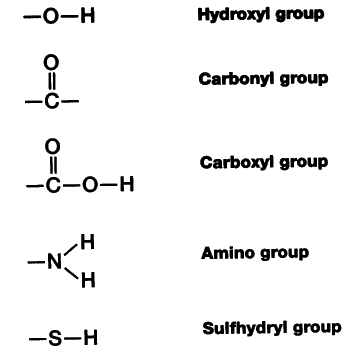
   1. What are the functional groups of organic compounds?
  They are hydroxyl group, carbonyl group, carboxyl group, amino group, phosphate group and methyl group.
   2. How can we recognize a phosphate group?
  We can do this by seeing the phosphate element into the example, expressed by (P)
   3. How can we recognize a carbonyl group?
  We can do this by seeing the double bond connection between the carbon (C) and the oxygen (O) in the example.
   4. How can we recognize an amino group?
  We can do this by seeing the single bond connection between the nitrogen (N) and the two hydrogens (H) in the example.
   5. What are polymers made of?
  Polymers are made of connected monomers. Poly means many, and mono means single.


Five main facts from the reading:
   1. Carbon - based molecules are called organic compounds.
   2. The variations in carbon skeletons are: length, branching, double bonds, and rings.
   3. Two monomers are connected by a reaction, called dehydration.
   4. Two monomers are broken down by a reaction, called hydrolysis.
   5. The four levels of protein structure are: primary, secondary, tertiary, and quaternary structure.


Diagram: 


This diagram shows the specific elements and connections of each of the functional groups of organic compounds and helps us recognize the different groups.


Link: http://users.rcn.com/jkimball.ma.ultranet/BiologyPages/H/H.html

Summary:
  The introductory section of this chapter talks about lactose.  Milk and other dairy products have long been recognized as highly nutritious foods, rich in protein and minerals necessary for healthy teeth and strong bones. For many people though these health benefits come with a digestive discomfort. Such people suffer from lactose intolerance, or the inability to properly break down lactose, the main sugar found in milk.
   After this the chapter talks about the life's molecular diversity, which is based on the properties of carbon. Carbon-based molecules are called organic compounds. Methane and other compounds composed of only carbon and hydrogen are called hydrocarbons. The chain of carbon atoms in an organic molecule is called a carbon skeleton. The different variations of carbon skeleton are: length, branching, double bonds, and rings. Compounds with the same formula, but different structures are called isomers. The next section of the chapter talks about the characteristic chemical groups, which help determine the properties of organic compounds. A hydroxyl group is consisted of a hydrogen atom bonded to an oxygen atom, which in turn is bonded to the carbon skeleton. In a carbonyl group, a carbon atom is linked by a double bond to an oxygen atom. A carboxyl group is consisted of a carbon double-bonded to an oxygen and also bonded to a hydroxyl group. An amino group is composed of a nitrogen bonded to two hydrogen atoms and the carbon skeleton. A phosphate group is consisted of a phosphorus atom bonded to four oxygen atoms. A methyl group is consisted of a carbon bonded to three hydrogens.
   The next section of the chapter talks about that cells make a huge number of large molecules from a small set of small molecules. Two monomers can be connected to one polymer by a dehydration reaction. During this reaction water is being released. One polymer can be broken down to two monomers by hydrolysis reaction. This reaction needs water to be successful. Monosaccharides are the simplest carbohydrates. The name carbohydrate refers to a class of molecules ranging from the small sugar molecules dissolved in soft drinks to large polysaccharides, such as the starch molecules we consume in pasta and potatoes. The carbohydrate monomers are monosaccharides. Cells link two single sugars to form disaccharides. We also learned about the high-fructose corn syrup and how unhealthy it is for us. After this the chapter talked about polysaccharides, which are long chains of sugar units. Then we learned that fats are lipids that are mostly energy-storage molecules. Lipids are divers compounds that are grouped together because they share one trait -  they mix poorly, if at all, with water. Lipids are hydrophobic, or in other words they do not like water. Phospholipids and steroids are important lipids with a variety of functions. Cells could not exist without phospholipids. The chapter also taught us that anabolic steroids pose health risks, and most of them are illegal, so it is better for us to stay away from them. Proteins, on the other side, are essential to the structures and functions of life. A protein is a polymer constructed from amino acid monomers. Proteins are made from amino acids linked by peptide bonds. Amino acids all have an amino group and a carboxyl group.  A protein's specific shape determines its function. A protein's shape depends on four levels of structure: primary, secondary, tertiary, and quaternary. We also learned that Linus Pauling contributed to our understanding of the chemistry of life. The last two things chapter talked about were the nucleic acids, which are information-rich polymers of nucleotides, and lactose tolerance, which is a recent event in human evolution.


Key Terms:
 1. Carbon skeleton - the chain of carbon atoms in an organic molecule.
 2. Isomers - compounds with the same formula but different structures.
 3. Hydrophilic - water-loving,
 4. Enzymes - specialized macromolecules that speed up chemical reactions in cells.
 5. Monosaccharides - the carbohydrate monomers.
 6. Fat - a large lipid made from two kinds of smaller molecules: glycerol and fatty acids.
 7. Saturated - fats with the maximum number of hydrogens.
 8. Unsaturated - fatty acids and fats with double bonds in the carbon chain.
 9. Anabolic steroids - synthetic variants of the male hormone testosterone.
10. Steroids - lipids whose carbon skeleton contains four fused rings.